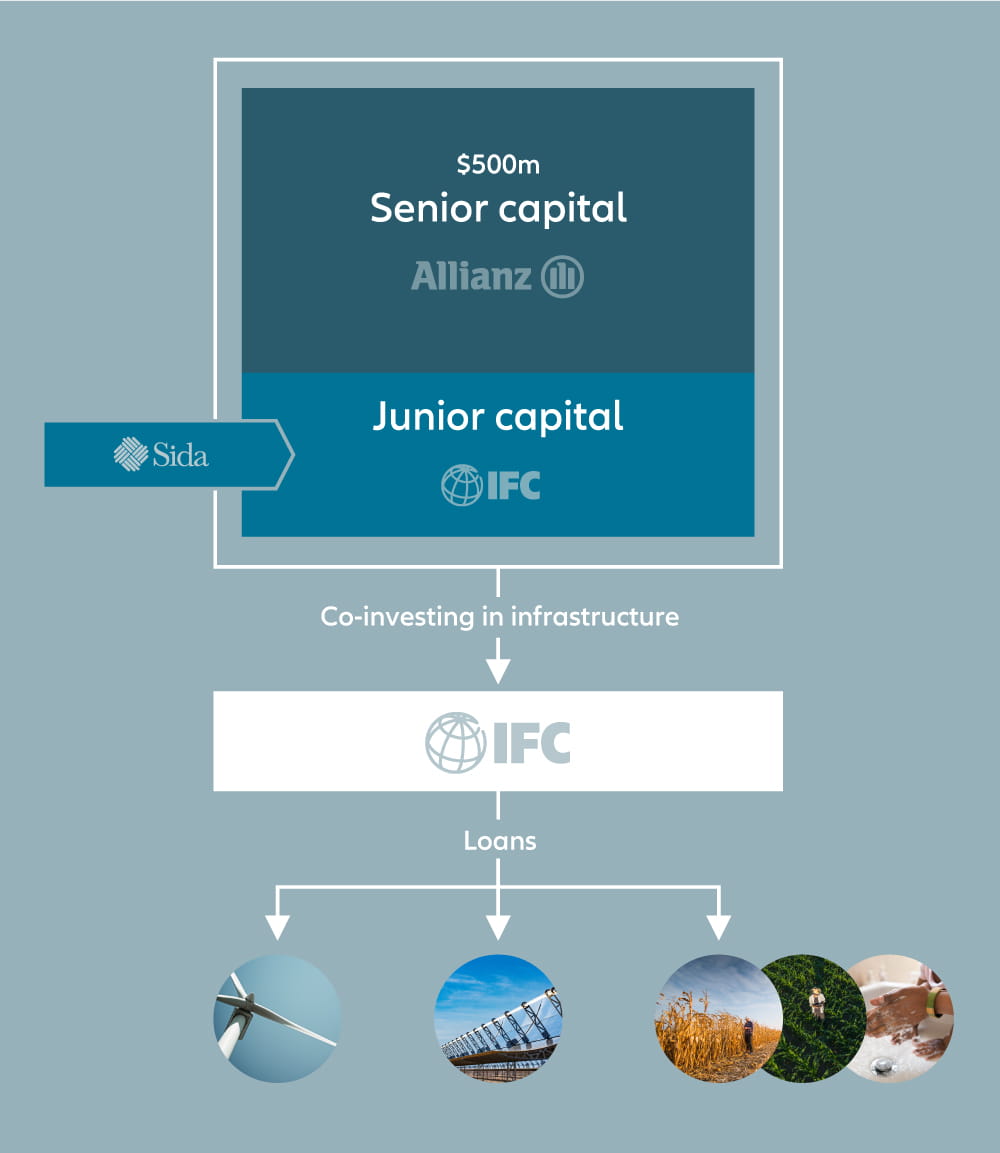

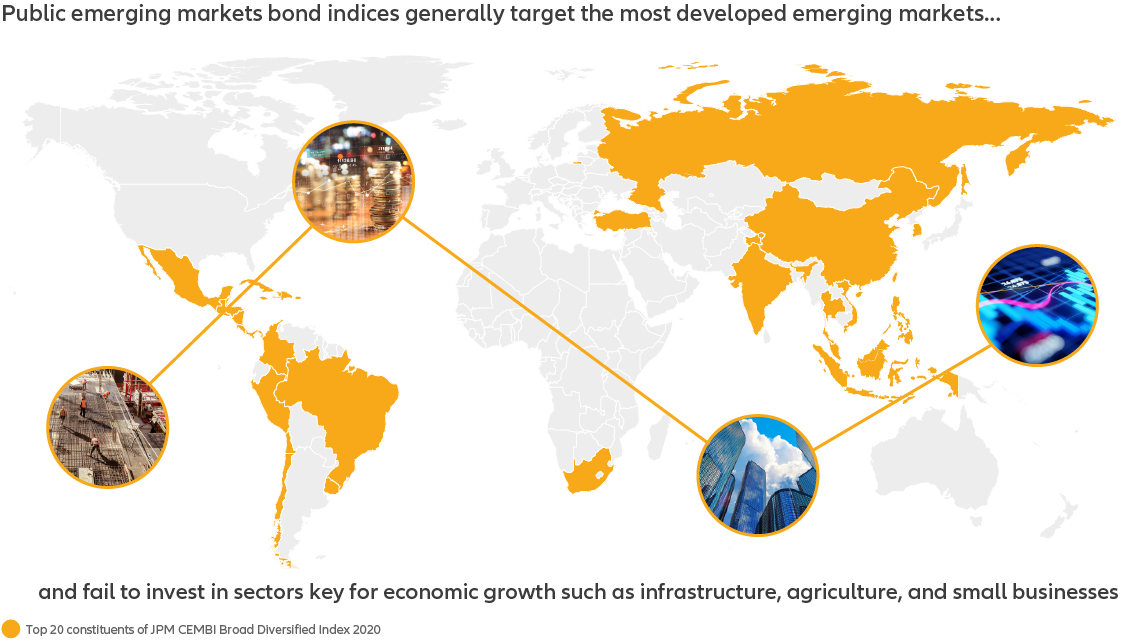
Capital markets mainly focus on investing in upper middle-income emerging markets and thus fail to direct funding to the countries where investment is needed the most
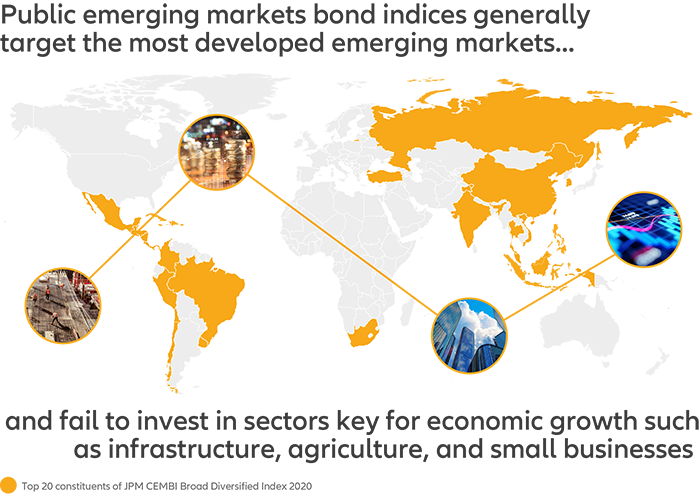
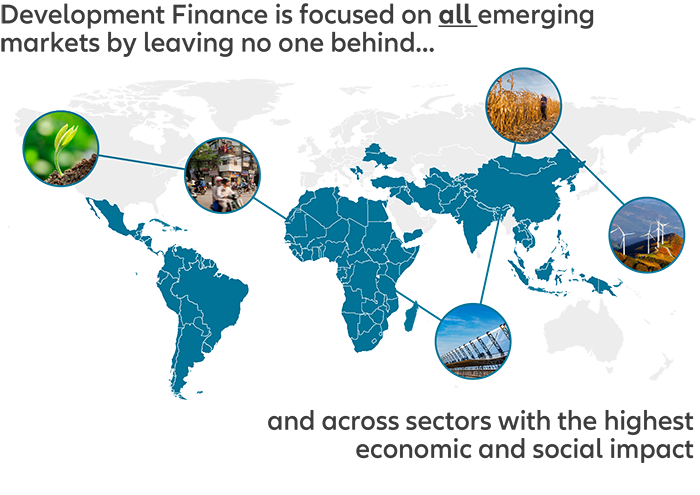


The United Nations Sustainable Development Goals (SDGs) launched in 2015 represent a universal call to action to end poverty and facilitate global peace and prosperity by leaving no one behind.
It is estimated that an additional $4.2 trillion of annual investment in Emerging and frontier Markets is needed







1) Source: United Nations Sustainable Development Goals website (link:https://sdgs.un.org/goals)
2) Allianz Global Investors supports Sustainable Development Goals (SDGs).
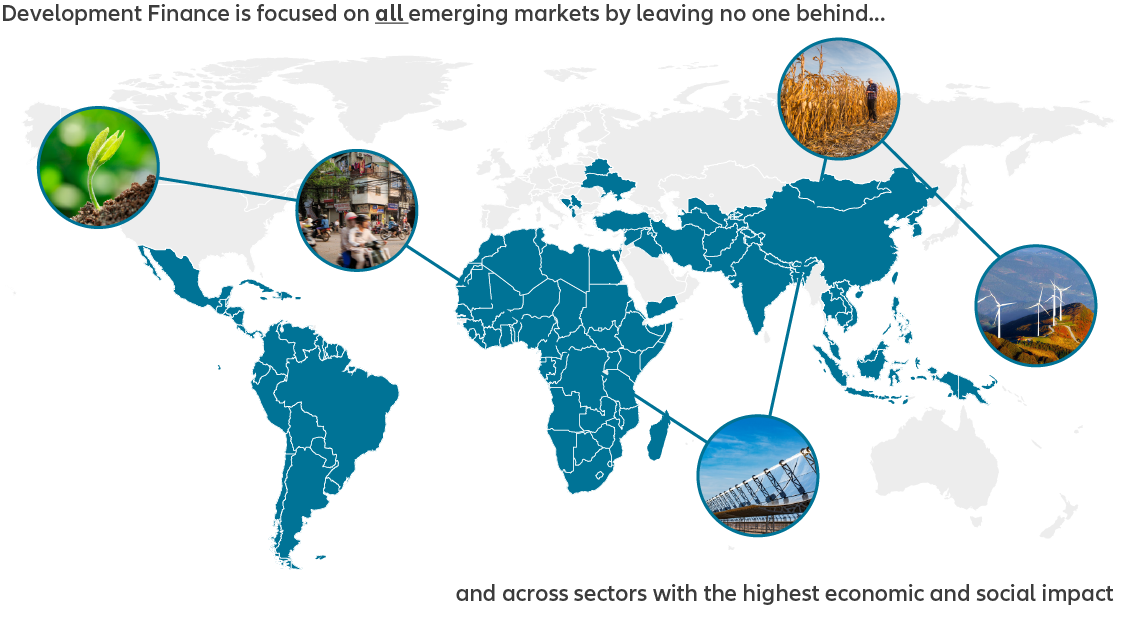
We believe it is through partnerships that we can achieve the SDGs by 2030. Therefore, we bring the public, philanthropic and private sectors together and draw on their expertise while also addressing their top priorities.
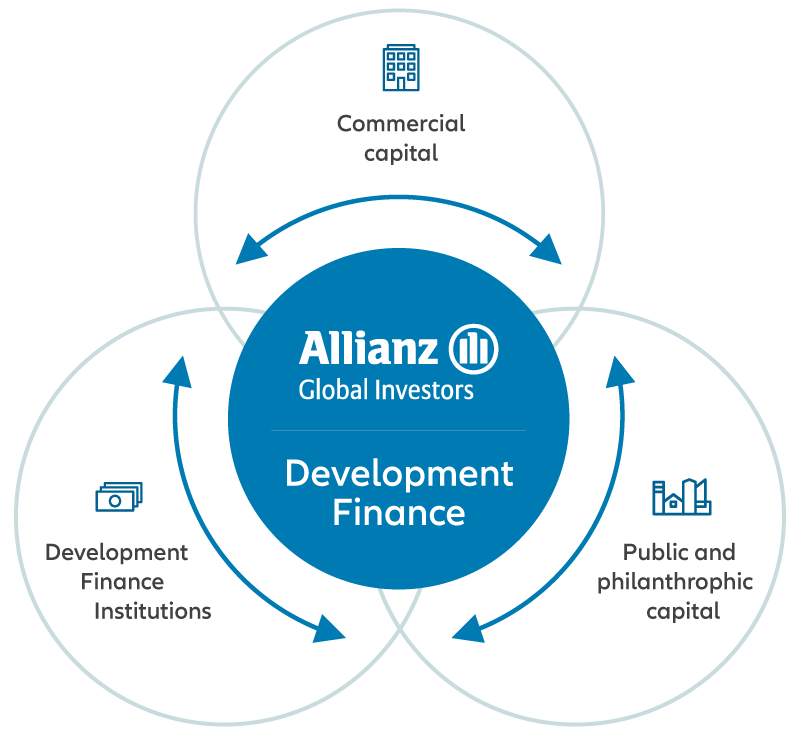
Please see below two example of live investment case studies
For illustrative purposes only. This information contained herein is solely for educational purposes and should not be relied upon as a forecast, research or investment advice and is not a recommendation to adopt any investment strategy. Any vehicle mentioned herein is closed for external investors.
The SDG Loan Fund described below is mentioned for illustrative purposes only. The fund is closed and no longer accepting new investments. AllianzGI is not advertising, promoting or soliciting new investments for this fund.

innovating blended finance
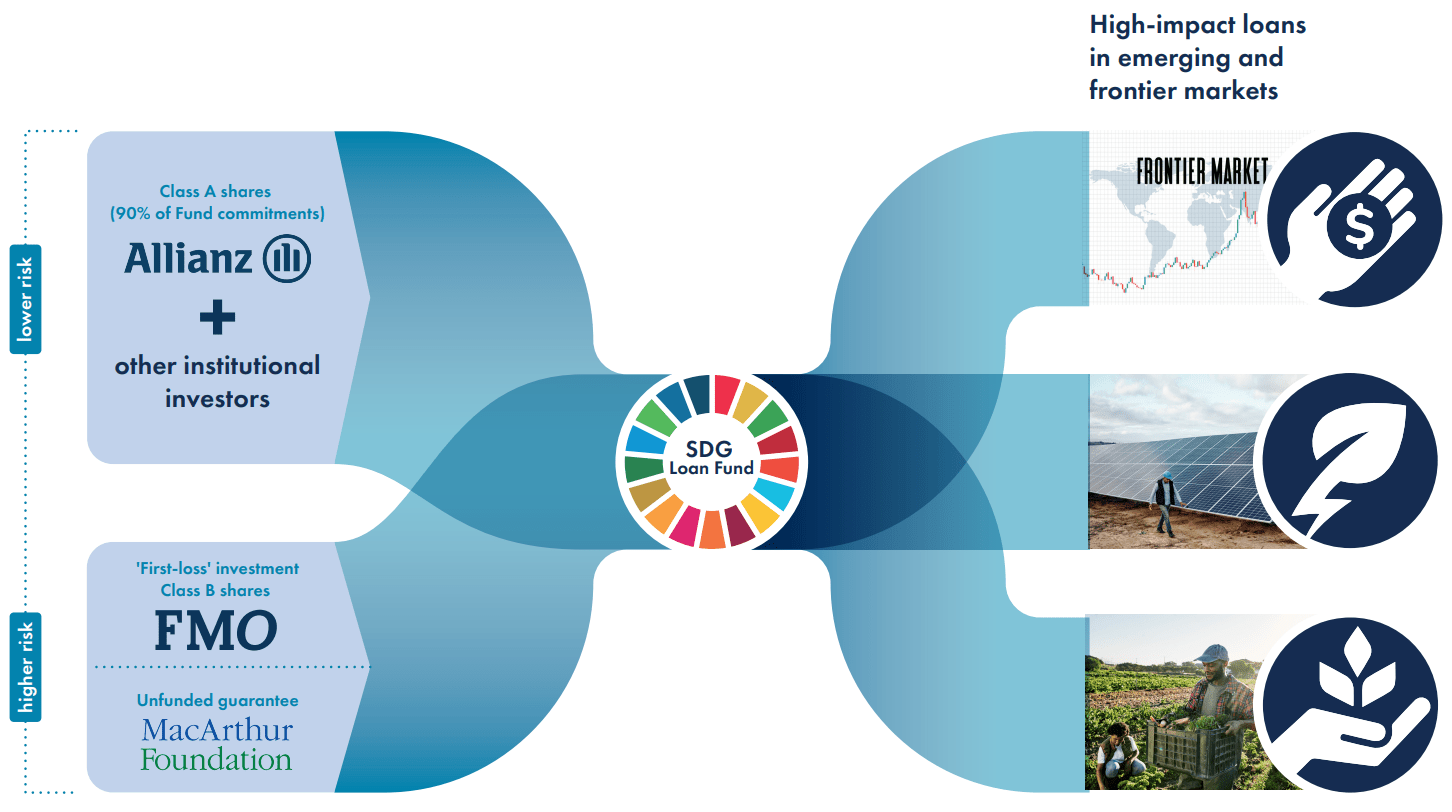
The SDG Loan Fund, which had its final closing in 2023, successfully mobilized US$1.1 billion of investor capital to advance the United Nations Sustainable Development Goals (SDGs) in emerging and frontier markets, using an innovative blended finance model.
The Fund allocates capital for the SDGs with a focus on SDG 8 (Decent work and economic growth), SDG 10 (Reduced inequalities), and SDG 13 (Climate action). The investments will be made in three primary sectors: agribusiness, financial institutions, and renewable energy. The SDG Loan Fund’s capital is invested as participations in FMO-originated loans, thereby granting the Fund priority access to FMO’s investment pipeline.
The Fund benefits from multiple layers of risk protection including a US$111 million first-loss investment from FMO, which is credit-enhanced with a US$25 million unfunded philanthropic guarantee provided by the John D. and Catherine T. MacArthur Foundation. Together, thesecatalytic investments unlock US$1bn of private capital from institutional investors who wouldn’t customarily be able to finance high-impact loans in emerging markets. With a total fund size of US$1.111 billion, the SDG Loan Fund is one of the largest blended finance funds launched in the market to date.
The SDG Loan Fund is designed to address the urgent need for capital to reach the SDGs in developing countries. Totaling US$3.9 trillion in 2020, this critical annual funding gap increased by 56 percent after the outbreak of COVID-19. Once fully invested in approximately 100 high-impact loan participations, the Fund’s investments aim to support close to 60,000 jobs and avoid approximately 450,000 tCO2eq of greenhouse gasses per annum according to FMO’s historical experience and analysis.
Investing involves risk. The value of an investment and the income from it will fluctuate and investors may not get back the principal invested. Past performance is not indicative of future performance. This is a marketing communication. It is for informational purposes only. This document does not constitute investment advice or a recommendation to buy, sell or hold any security and shall not be deemed an offer to sell or a solicitation of an offer to buy any security. The views and opinions expressed herein, which are subject to change without notice, are those of the issuer or its affiliated companies at the time of publication. Certain data used are derived from various sources believed to be reliable, but the accuracy or completeness of the data is not guaranteed and no liability is assumed for any direct or consequential losses arising from their use. The duplication, publication, extraction or transmission of the contents, irrespective of the form, is not permitted.
This material has not been reviewed by any regulatory authorities. In mainland China, it is for Qualified Domestic Institutional Investors scheme pursuant to applicable rules and regulations and is for information purpose only. This document does not constitute a public offer by virtue of Act Number 26.831 of the Argentine Republic and General Resolution No. 622/2013 of the NSC. This communication's sole purpose is to inform and does not under any circumstance constitute promotion or publicity of Allianz Global Investors products and/or services in Colombia or to Colombian residents pursuant to part 4 of Decree 2555 of 2010. This communication does not in any way aim to directly or indirectly initiate the purchase of a product or the provision of a service offered by Allianz Global Investors. Via reception of his document, each resident in Colombia acknowledges and accepts to have contacted Allianz Global Investors via their own initiative and that the communication under no circumstances does not arise from any promotional or marketing activities carried out by Allianz Global Investors. Colombian residents accept that accessing any type of social network page of Allianz Global Investors is done under their own responsibility and initiative and are aware that they may access specific information on the products and services of Allianz Global Investors. This communication is strictly private and confidential and may not be reproduced. This communication does not constitute a public offer of securities in Colombia pursuant to the public offer regulation set forth in Decree 2555 of 2010. This communication and the information provided herein should not be considered a solicitation or an offer by Allianz Global Investors or its affiliates to provide any financial products in Brazil, Panama, Peru, and Uruguay. In Australia, this material is presented by Allianz Global Investors Asia Pacific Limited (“AllianzGI AP”) and is intended for the use of investment consultants and other institutional/professional investors only, and is not directed to the public or individual retail investors. AllianzGI AP is not licensed to provide financial services to retail clients in Australia. AllianzGI AP is exempt from the requirement to hold an Australian Foreign Financial Service License under the Corporations Act 2001 (Cth) pursuant to ASIC Class Order (CO 03/1103) with respect to the provision of financial services to wholesale clients only. AllianzGI AP is licensed and regulated by Hong Kong Securities and Futures Commission under Hong Kong laws, which differ from Australian laws.
This document is being distributed by the following Allianz Global Investors companies: Allianz Global Investors GmbH, an investment company in Germany, authorized by the German Bundesanstalt für Finanzdienstleistungsaufsicht (BaFin); Allianz Global Investors (Schweiz) AG; in HK, by Allianz Global Investors Asia Pacific Ltd., licensed by the Hong Kong Securities and Futures Commission; in Singapore, by Allianz Global Investors Singapore Ltd., regulated by the Monetary Authority of Singapore [Company Registration No. 199907169Z]; in Japan, by Allianz Global Investors Japan Co., Ltd., registered in Japan as a Financial Instruments Business Operator [Registered No. The Director of Kanto Local Finance Bureau (Financial Instruments Business Operator), No. 424], Member of Japan Investment Advisers Association, the Investment Trust Association, Japan and Type II Financial Instruments Firms Association; in Taiwan, by Allianz Global Investors Taiwan Ltd., licensed by Financial Supervisory Commission in Taiwan; and in Indonesia, by PT. Allianz Global Investors Asset Management Indonesia licensed by Indonesia Financial Services Authority (OJK).
ADM-4167620