


House View
House View Q2 2026: Holding the line

Our view of global markets
Test of resilience
- Global markets enter the second quarter navigating a more complex backdrop than many expected at the start of the year. The conflict in the Middle East adds a fresh layer of geopolitical uncertainty that could prove a significant test for the global economy. Outcomes hinge on how long warfare persists and the scale of energy-market disruption. While effects are still unfolding, the conflict has already heightened risks to growth and inflation, particularly for energy-dependent economies in Europe and Asia.
- Even so, our core view remains one of “bending but not breaking”. The global economy still shows resilience, supported by strong investment in artificial intelligence – now a key pillar of growth, especially in the US. But higher energy costs may keep inflation above central bank targets in several major economies, limiting the scope for policy easing. We now expect the US Federal Reserve’s next cut in the second half of 2026, with the Bank of England likely to proceed cautiously. Higher energy prices are also a factor behind our downgrade to euro zone growth.
- We see oil prices in the USD 90-110 range as manageable – the greater risk comes if levels stay elevated for an extended period, raising the threat of a more stagflationary mix of higher inflation and weaker growth and challenging the consensus “Goldilocks” narrative. This backdrop favours resilience‑building: diversified portfolios and a focus on long‑term goals can help investors look through near‑term volatility.
- Against this backdrop, our asset class convictions emphasise selective duration, quality carry and equity themes aligned with strategic autonomy – including defence – and the AI enablers driving the next phase of technological transformation. We remain structurally cautious on the US dollar, despite short-term gains as a safe haven.

Chart of the quarter
What is the economic impact of higher oil prices?
Crude oil underpins countless products and supply chains. The chart shows the range of estimates of how every supply‑driven 10% increase in oil prices would affect GDP and inflation, with the dots representing the average estimated impact.
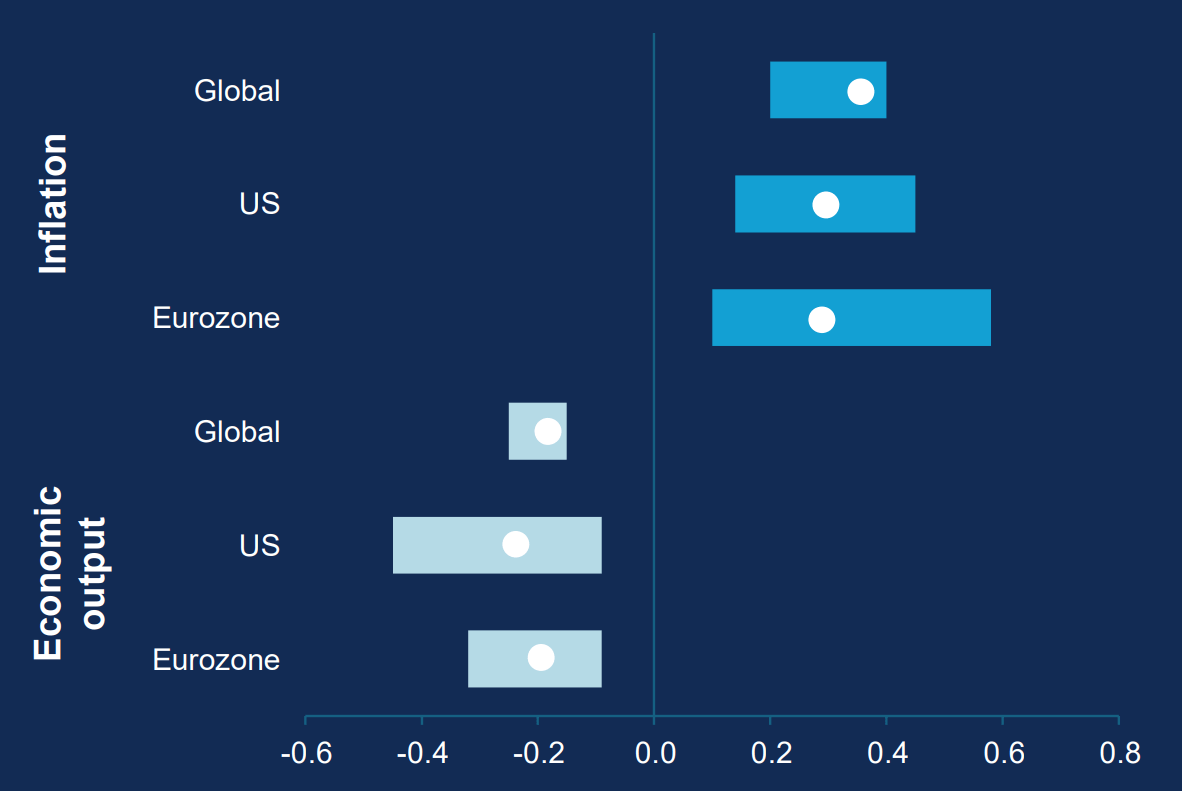
Source: AllianzGI Economics & Strategy. Note: Sensitivities based on 68 individual estimates by central banks (US Federal Reserve, European Central Bank, Bank of Canada, Oesterreichische Nationalbank, Banco de España), international organisations (IMF, OECD, World Bank, World Economic Forum), and academic and financial institutions (JPMorgan, Goldman Sachs, Morgan Stanley, BNP Paribas, Société Générale, Deutsche Bank, UBS, HSBC). Estimates exclude second-round effects from higher natural gas prices, particularly in the euro zone, as well as potential non-linearities.