

Achieving Sustainability
ESG ratings - still relevant?



Over the past decade, the ESG data landscape has continued to advance. Yet ESG ratings – which assess companies’ performance on environmental, social and governance factors – continue to serve as a common framework among investors, regulators and corporations. While they remain relevant, there is a need for innovation.
ESG ratings1 – provided by sustainability data providers – support investment decisions in both public and private markets across asset classes. They help investors understand the sustainability profiles of issuers and influence the selection of investments. Additionally, they can enable monitoring and improvement of sustainability practices.
The challenge is how ESG ratings can be refined to drive meaningful and resilient sustainable investing outcomes. In our view, exclusive dependence on thirdparty providers has its limits. The last few years have witnessed numerous mergers and the discontinuation of data services, underscoring the importance of cultivating resilience and independence within ESG data processes.2
With the availability of more sophisticated data, increasing regulatory scrutiny and a growing demand from clients for nuanced assessments, the conversation around ratings and scores is now about reaffirming their effectiveness and value for investors and clients.
ESG ratings: a compass for investors
We think ESG ratings will continue to serve as a pivotal measure shaping the sustainability profile of sustainable investment funds – a universe of more than 13,000 sustainable funds in the EU3 representing EUR 6.8 trillion4 in assets under management. The reasons are simple:
- Simplicity – consolidating multiple ESG key performance indicators (KPIs)/data points into one single, actionable score or rating maximises their usefulness.
- Usability – absolute and sector-relative scores serve as valuable tools to guide selection of assets and support diversified best-in-class portfolios.
- Experience – clients have a longstanding history of using ESG ratings or scores and are highly familiar with how to interpret them.
With data and technology continuing to advance, investors are increasingly evaluating customisable ESG ratings/scores to better align portfolio strategies with their ambitious sustainability objectives – driving not just compliance, but genuine impact across the sector.
Avoiding the blind spot
Investors can choose to apply specific KPIs or screen for controversies as alternatives to ESG ratings. However, building a well-diversified portfolio involves a fine balance between quality and coverage of data. Concentrating on a single metric or theme means focusing on only one risk or dimension, while in reality, investors often prefer to account for multiple factors affecting companies’ valuations.
The individual elements of an ESG rating are as important as the final aggregated result. The scores and weightings across environmental, social and governance factors provide critical insights into the calculation of the final rating. But more importantly, they are interconnected in contributing to the long-term sustainability and risk management of a company. Therefore, it is essential that no component is completely overlooked.
Having blind spots in one area – such as ignoring governance or social risks – can expose investors and companies to unexpected challenges and undermine effective decision-making. In practice, investors should use ESG ratings, KPIs and controversies together.
A new era of transparency
Poor transparency and comparability have undermined ESG ratings for a long time. Investor demand and new regulations5 are driving change to combat greenwashing risks and boost investor confidence in sustainable investments. From this year, ESG rating providers must meet new transparency standards under the new EU ESG Rating Regulation supervised by European Securities and Markets Authority (ESMA), covering data sources, methodologies, model assumptions and rating processes.6
Could this new regulation bring an end to proprietary ratings and scores? On the contrary, we believe proprietary sustainability assessments are crucial for leading asset managers to demonstrate their institutional conviction in guiding investments on sustainability topics. They also maintain a certain independence from the volatility or disruption of external data sources. In our view, the major ESG data providers serve a high-level role for markets, while proprietary tools serve a specific role for our clients and funds.
“Our new proprietary sustainability scores reflect our belief that sustainability is not static – it evolves with market, technology and client expectations. A more resilient scoring system with diversified data sources is therefore essential in our view.”
Thomas Roulland, Head of Sustainability Standards & Analytics
A future powered by CSRD x AI
The crucial role of ESG ratings means they are here to stay, but we see two forces driving their evolution. The first is ongoing improvements in corporate data through the Corporate Sustainability Reporting Directive (CSRD) and International Sustainability Standards Board (ISSB) reporting frameworks. The second is artificial intelligence (AI) and related technologies.
While the former will improve quality – through audited data points and a focus on reporting – the latter will enhance more independent collection, aggregation, monitoring and distribution of data for stakeholders.
We know that clients need assurance of how data is collected, how it contributes to scores/ratings, and how these link to real-world performance. Ultimately, the effectiveness of any ESG methodology lies in its ability to deliver tangible benefits to investors and innovative sustainability-themed products.
Evolution not revolution
In 2025, AllianzGI evolved its own ESG data methodology – the proprietary sustainability score (PSS) – which gives our investment professionals a transparent assessment framework of the sustainability performance of corporates and sovereigns. The PSS is used as a “binding element”– a specific requirement built into the categorisation of our socially responsible investing (SRI) strategies representing EUR 58
billion7 of our assets under management (typically classified as Article 8 under SFDR8). We consider the result to be a significant improvement in both methodology and usability, in particular for corporate issuers.
In Exhibit 1 we show the full journey of the AllianzGI proprietary sustainability score (PSS) for the Health Care & Pharmaceutical sector:
- The first two charts on the left show the distribution of absolute scores for a global universe and then the European companies in the sector. The absolute score provides a market view of the companies in scope.
- In the second step, we compute the relative scores through a best-in-class transformation of the absolute scores of all companies in the same sector and region to allow for a quick and intuitive peer-group comparison – in this example, Health Care & Pharmaceutical in Europe. The relative score provides an actionable tool for our investment teams where worst, middle and best-in-class companies are highlighted for intuitive asset selection.
- Step three shows the redistribution of the relative scoring after applying our Human Rights and Exclusion flags.
Exhibit 1: Distribution of AllianzGI sustainability scores for the Health Care & Pharmaceutical sector*

*The Proprietary Sustainability Score is based on third-party ESG data and internal research. It reflects AllianzGI’s Sustainability teams’ subjective view and relies on evolving assumptions. Peer groups for corporates, sectors and regions are defined internally, which may introduce biases. Despite efforts to ensure data quality, gaps, estimates and time lags may affect accuracy. The score is not a definitive measure of sustainability and may be used as one input among others in investment decisions.
Source: AllianzGI, 2025. PSS: Proprietary Sustainability Score. HR Flag: Human Rights Flag. For illustration purposes only.
Through the evolution of our data methodology, we reviewed all the indicators used in the model to ensure relevance and precision, the conviction-based materiality and weights of sub-factors/factors – see Exhibit 2 – and the aggregation methodology.
With regard to conviction, the qualitative judgement of our sustainability research analysyts (example in Exhibit 2) complements quantitative data to further refine our scores. This supports a more independent stock/bond selection process to efficiently drive the sustainability profile of sustainable funds.9 Combined with our exclusion policy, including a human rights flag, this methodology helps to ensure the integrity of our sustainable investing approach.
“The new PSS for corporate issuers transforms analysts’ expertise into value-added actions and insights. We believe the richness of the signal can empower stronger conviction in stock selection and elevate our sustainability insights across the firm.”
Marie Navarre, Head of Sustainability Research
Exhibit 2: Materiality analysis for social factors of the Automotives sector

Source: Allianz Global Investors, Sustainability Research 2025
The new scores are powered by our Sustainability Insights Engine (SusIE) – a proprietary digital tool dedicated to the aggregation and distribution of our sustainability data. SusIE ensures scalability, speed and integration across the different layers of investment oversight.
In particular, for corporate issuers, the introduction of 16 sub-factor scores underlying the four main factors of our scores – environmental, social, business behavior and corporate governance – expands transparency and allows investors to better understand how scores are derived and the drivers of a high/poor score – see Exhibit 3. The methodology also creates more transparency for investors by introducing sectoral and regional adjustments that allow issuers to be compared against their peers. This helps diversify the allocation of risks.
Exhibit 3: Illustration of a sustainability profile with 4 factors and 16 sub-factors scores for an automotive company

Source: Allianz Global Investors, 2025
We see AllianzGI’s PSS as a complementary tool to third-party ESG ratings turning ESG data into decision-useful insights that strengthen the credibility of our analysis, enhance risk management, and support long-term value creation across our investments. This brings several benefits:
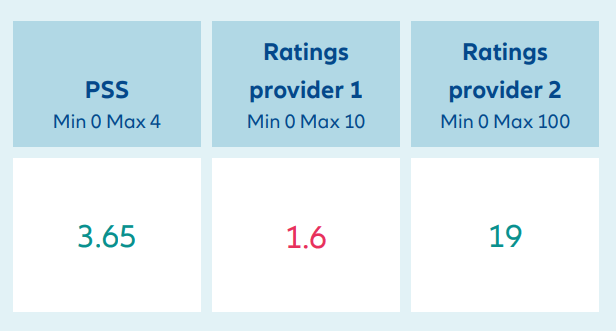
- ESG ratings vary widely across providers due to differences in philosophy (eg, risk vs disclosure), methodology, and data used. PSS offers a diversified view – see Exhibit 4.
- Unlike external ESG ratings, the factors’ weights of PSS let us target the most relevant factors by sector aligned with our long-term vision as an asset manager.
- Finally, PSS provides an explainable, flexible and accountable solution for clients, lowering “black-box” risks from third-party ratings.
Exhibit 4: Illustration of ESG scores divergence for an automotive company
Data as at end of December 2025
In conclusion, by combining conviction, transparency and innovation, we think this new scoring system positions us – and our clients – for success in a world where sustainable investing is no longer optional, but essential.
1. Regulation (EU) 2024/3005, 2024, art. 3: “ESG rating” means an opinion or a score, or a combination of both, regarding a rated item’s profile or characteristics with regard to environmental, social and human rights, or governance factors, or regarding a rated item’s exposure to risks
or impact on environmental, social and human rights, or governance factors, that is based on both an established methodology and a defined ranking system of rating categories, irrespective of whether such ESG rating is labelled as “ESG rating”, “ESG opinion” or “ESG score”.
2. In December 2024, ratings agency Moody’s discontinued its ESG data services.
3. Classified as Article 8 and 9 under the EU Sustainable Finance Disclosure Regulation (SFDR).
4. Source: Morningstar. Data as of September 2025. Based on SFDR data collected from prospectuses of 98% of funds available for sale in the EU, excluding money market funds, funds of funds, and feeder funds. Report: https://www.morningstar.com/en-gb/business/insights/research/
sfdr-article8-article9.
5. ESG Rating Regulation (Reg. 2024/3005), https://www.esma.europa.eu/esmas-activities/investors-and-issuers/esg-rating-providers
6. ESG Rating Regulation (Reg. 2024/3005), https://www.esma.europa.eu/esmas-activities/investors-and-issuers/esg-rating-providers
7. Source: AllianzGI as of September 2025.
8. For our sustainability and impact-focused strategies categorised as Article 8 or 9 we apply at least one of two binding elements: our sustainable minimum exclusions policy and/one of our sustainable investment approaches. Each binding element is measurable and reportable.
9. Classified as Article 8 and 9 strategies in line with SFDR.