


Five themes shaping 2026 | ~5 min read
Theme 3: Digital resilience – more data, less downtime

In our third theme for 2026 we explore the extraordinary pace of technology development and consider the essential safeguards and infrastructure needed for the sector’s growth.
Digital technologies are increasingly permeating our lives and the economy. This is illustrated by the proliferation of data centres – a global market valued at USD 242 billion, rising to over USD 584 billion by 2032 according to the World Economic Forum (WEF). The question is whether this accelerated growth in digital capabilities has been accompanied by equivalent progress in key supporting areas which are emerging as critical to sustainable long-term opportunities in technology.
Below we highlight the five factors that we believe will need to be significantly scaled up for a more resilient digital infrastructure. Each of these factors will determine the structural positioning of fast-evolving technologies and their ability to seize the opportunities and mitigate external risks.
Building blocks of resilient digital future
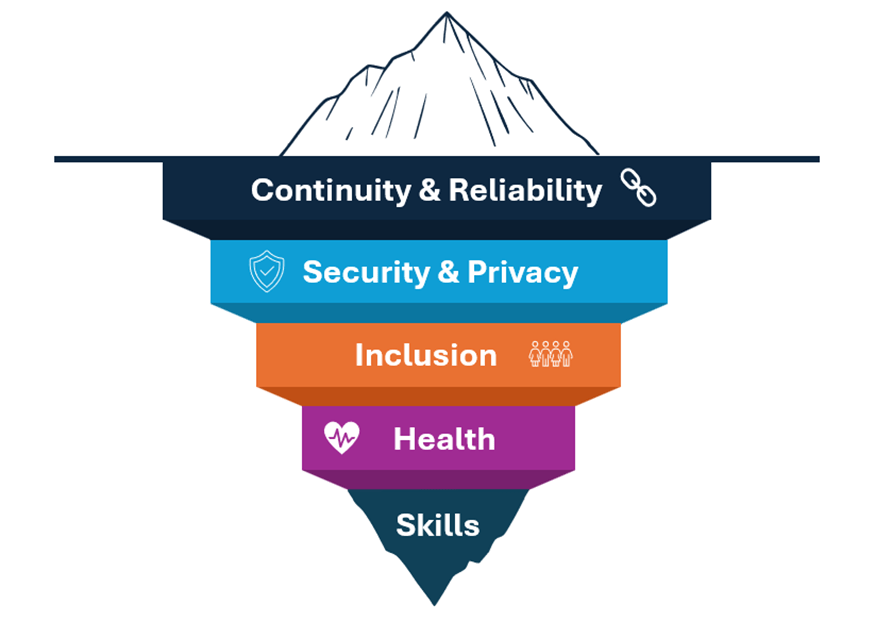
- Continuity and reliability – the criticality of, and dependence on, digital services and systems need to be matched by resilience of uptime and performance.
- Security and privacy – how data is used, the integrity of its aggregation, and its protection from misuse are all critical, while security is the core foundation of protecting digital systems.
- Inclusion – technology has the capacity to narrow or widen the digital divides that already exist within society. Enhancing digital inclusion extends from providing equitable access to hardware, software and literacy to improving reach to remote communities.
- Health – with growing evidence of links to health risks – like anxiety, sleep disruption and addiction – there need to be appropriate safeguards around the rising interaction, and perhaps dependence on technology.
- Skills – the rise of digital technology is shaping how the jobs of the future are conducted – as highlighted in our modern workforce article – and is an extension of the inclusion topic. A coordinated and structured approach to upskilling the broader workforce is required, especially in sectors most impacted by the transition.
Did you know
- A third of people globally still lack internet access – according to a WEF report – a proportion which increases for women, rural populations and low-income groups.
- A WEF cyber awareness report highlights that the average number of weekly cyber attacks per organisation has more than doubled since 2021, reaching 1,984 incidents per week in 2025.
The importance of digital resilience cannot be underestimated. The breadth and depth of digital innovations will greatly influence the global transition to an economic model that addresses future climate, planetary and social scenarios.
As tech becomes more embedded into our daily lives, these factors become increasingly important globally. We see 2026 as the year when digital resilience grows into its next developmental phase.
Read more: